Precision Motion for Fiber Assembly & Inspection
Simplifying automated connector alignment and inspection for data center infrastructure.
Motion Challenges in Modern Data Center Fiber Infrastructure
As data centers scale to support higher bandwidth, higher port density, and faster deployment cycles, fiber optic assembly and inspection processes are under increasing pressure. Connector alignment tolerances continue to tighten, while production volumes and inspection throughput steadily rise. Small variations in positioning during assembly or probing can lead to signal degradation, rework, or long‑term reliability issues that directly impact uptime.
Manual and semi‑manual processes struggle to keep pace with these demands. Automation introduces clear benefits—but only when the underlying motion system delivers predictable, repeatable positioning without adding unnecessary complexity. For fiber optic assembly and inspection equipment, linear motion performance becomes a critical contributor to yield, consistency, and scalability.
Hybrid linear actuators offer a practical path forward by combining compact form factors with stable open‑loop performance. When applied correctly, they enable precise alignment, controlled engagement, and repeatable inspection motion—supporting the transition from labor‑intensive processes to scalable, automated or Fiber‑Centric Automation
Fiber assembly and inspection applications place unique demands on linear motion systems. Actuators must maintain consistent positioning across repeated cycles while remaining compact enough to integrate into dense tooling layouts. Open‑loop operation is often preferred for system simplicity, provided accuracy and repeatability remain tightly controlled.
Hybrid linear actuators address these requirements by delivering predictable motion behavior across the full stroke. Their mechanical design supports stable alignment for connector assembly, ferrule positioning, and inspection probing—without relying on closed‑loop feedback for every application. This balance of performance and simplicity helps reduce system cost, integration effort, and long‑term maintenance.
These characteristics make hybrid actuators well suited for a wide range of fiber‑centric tasks, from single‑station benchtop inspection systems to multi‑axis automated assembly platforms deployed in high‑volume data center manufacturing environments.
Validated Open‑Loop Accuracy and Repeatability
How consistent is open‑loop motion in real‑world fiber applications?
To characterize linear accuracy and repeatability, hybrid actuators were measured using a laser interferometer across multiple runs. The error‑versus‑stroke data below illustrates consistent, tightly bounded positioning behavior throughout the actuator’s travel.
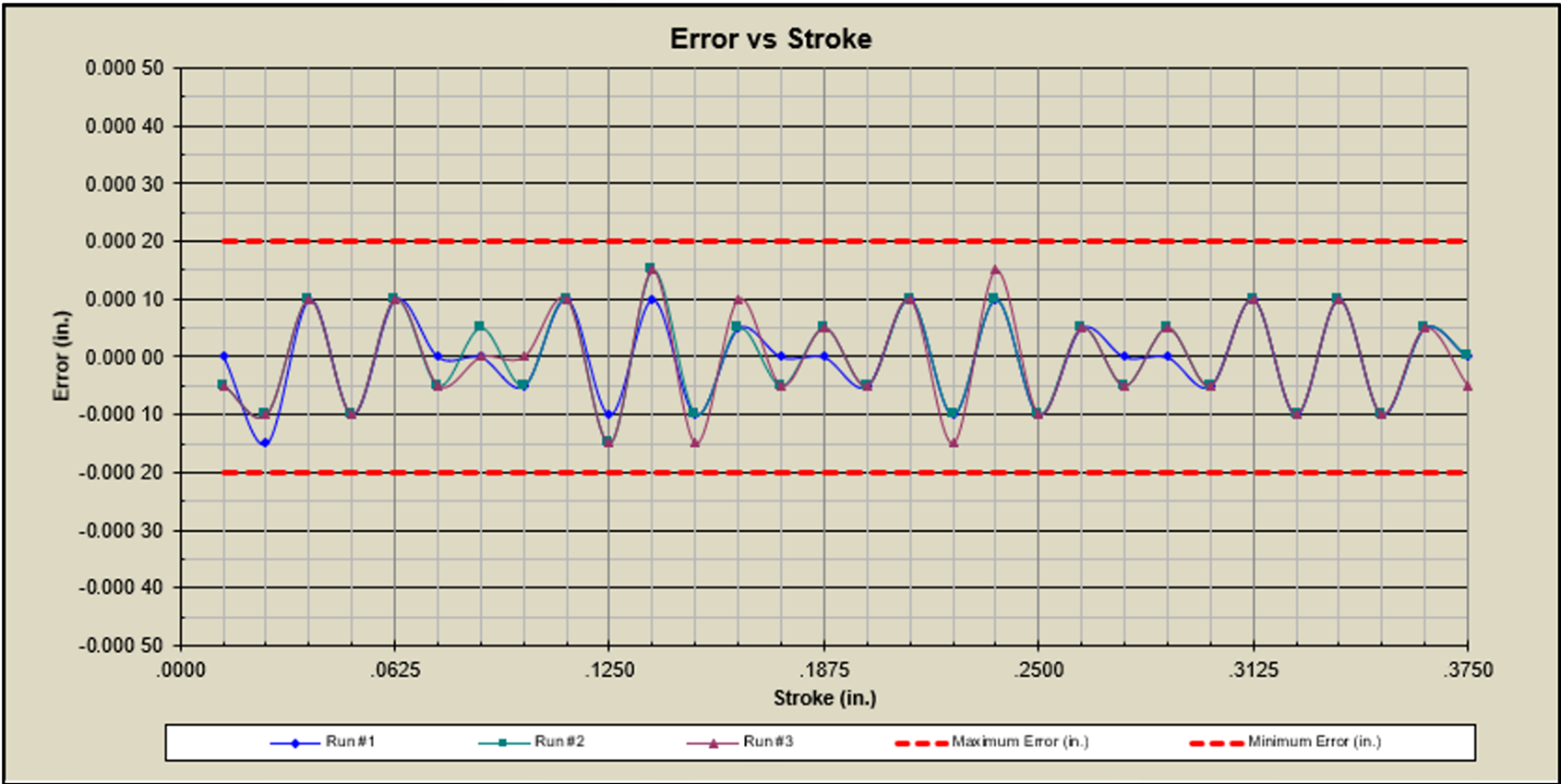
Measured open‑loop, direct output from Laser Interferometer, showing linear accuracy and repeatability across multiple runs
The results demonstrate repeatable motion performance with minimal variation between cycles—an essential requirement for fiber optic alignment and inspection processes where positional drift can compromise optical performance. This level of predictability allows equipment designers to confidently implement open‑loop motion while maintaining control over process variation, yield, and long‑term reliability.
Recommended Products for Fiber Assembly & Inspection
Compact Alignment and Inspection Motion
Ultra‑compact linear positioning for probing and inspection tasks where space is limited.
Lightweight linear motion for inspection tooling, sensor positioning, and fine alignment. Multiple encoder options are available, along with anti-backlash nuts, and multiple spline shaft materials.
Compact hybrid actuator on 16mm frame, supporting precise motion for connector handling and assembly.
Higher force and smaller native linear resolution, supporting the finest positioning axes
Integrated guidance for applications requiring enhanced linear stability and alignment consistency.
Supporting the Infrastructure That Moves Data
From connector assembly to inspection automation, linear motion performance plays a direct role in enabling reliable, high‑density data center infrastructure. Hybrid linear actuators provide the accuracy, repeatability, and scalability needed to support fiber‑centric manufacturing and inspection processes—helping equipment designers move data efficiently, consistently, and with confidence.
Frequently Asked Questions
1. What is motion control in data centers?
Motion control in data centers refers to the use of actuators, motors, and control systems to enable precise movement of components such as airflow dampers, cooling louvers, server racks, and access mechanisms. These systems ensure accurate positioning, automation, and responsiveness—critical for maintaining thermal stability, uptime, and efficient facility operation.
2. How are actuators used in data center infrastructure?
Data center actuators are widely used in cooling and infrastructure systems to control airflow, fluid flow, and mechanical access. For example:
- Linear actuators adjust cooling louvers and dampers for airflow regulation
- Actuated valves control chilled water loops and cooling systems
- Compact actuators automate server rack access and enclosure mechanisms
These applications help maintain optimal temperatures and enable automated infrastructure control.
3. How do linear actuators improve data center airflow control?
Linear actuators for data centers provide smooth, precise movement to adjust airflow components like dampers, vents, and containment panels. This allows:
- Real-time airflow balancing
- Improved hot/cold aisle containment
- Adaptive cooling based on server load
Accurate airflow control reduces overheating risks and supports energy-efficient cooling strategies.
4. What type of actuators are best for data center cooling systems?
The best actuators for data center cooling systems are electric linear actuators and hybrid stepper actuators due to their precision, programmability, and low maintenance requirements.
They offer:
- Fine position control for valves and dampers.
- Integration with Building Management Systems (BMS) and Data Center Infrastructure Management (DCIM) systems.
- Reliable 24/7 operation in controlled environments.
These features make them ideal for advanced cooling architectures and automation.
5. How can motion control solutions improve data center energy efficiency?
Motion control solutions improve data center energy efficiency by dynamically adjusting cooling and airflow systems based on real-time demand.
Key benefits include:
- Reduced energy waste by optimizing cooling output
- Improved thermal management across racks and rooms
- Lower Power Usage Effectiveness (PUE) through smart automation
Automated actuators ensure cooling systems run only at required capacity, minimizing operational costs.
6. What are hybrid stepper actuators and why are they used in data centers?
Hybrid stepper actuators combine the precision of stepper motor control with integrated linear motion, delivering highly accurate and repeatable positioning in a compact form factor.
In data centers, they are used for:
- Enclosure and access control systems
- Cooling component positioning
- Space-constrained automation applications
7. How do HKP actuators improve data center reliability and prevent downtime?
HKP actuators enhance data center reliability by providing consistent, predictable motion for critical systems such as cooling control and access hardware.
For example:
- Compact solutions like Size 6 actuators enable reliable operation in tight spaces
- Controlled motion ensures fail-safe conditions (e.g., backdrive capability during power loss scenarios).
- Precision actuation reduces mechanical stress and system failure risks
By enabling automated, reliable motion control systems, HKP actuators help prevent downtime in mission-critical environments.
8. Why choose open‑loop motion for fiber assembly and inspection?
Open‑loop systems reduce complexity, cost, and integration effort when actuator accuracy and repeatability are well controlled. For many fiber alignment and inspection tasks, predictable mechanical performance meets application requirements without the overhead of closed‑loop feedback.
9. How does motion accuracy impact fiber performance?
Small positional errors during assembly or inspection can affect connector alignment, insertion loss, and repeatability. Consistent linear motion helps ensure inspection results reflect actual connector quality rather than process variation.
10. Are hybrid actuators suitable for scalable automation?
Yes. Their compact design and stable motion characteristics make them suitable for single‑station tools as well as multi‑axis automated systems used in higher‑volume production environments.