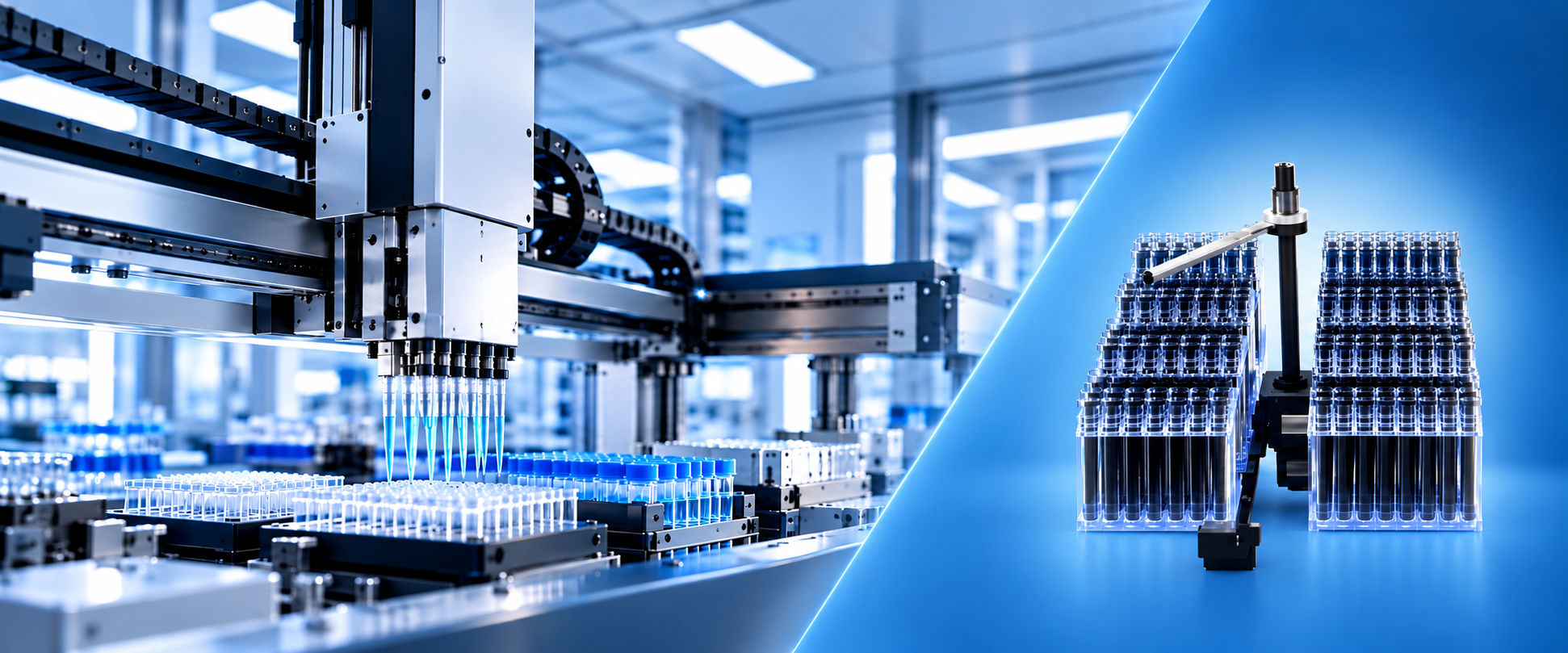
Powering the Next Generation of Laboratory Automation
Laboratory instrumentation manufacturers face growing demands for higher throughput, greater accuracy, and more automated workflows. From diagnostic analyzers and liquid handling systems to genetic sequencing and analytical instruments, precision motion is at the heart of modern laboratory automation.
Haydon Kerk Pittman motion solutions help OEMs achieve precise positioning, accurate fluid control, reliable sample handling, and long-life performance in mission-critical applications. With a broad portfolio of linear and rotary motion technologies, we help engineers develop innovative laboratory instruments that deliver the accuracy, repeatability, and reliability today's laboratories require.
Applications in Laboratory Automation
Haydon Kerk Pittman motion solutions support a wide range of laboratory automation and analytical instrumentation applications. Our precision linear and rotary motion technologies help OEMs improve accuracy, repeatability, throughput, and reliability in demanding laboratory environments.
Common applications include:
- Automated liquid handling and reagent dispensing
- Electronic pipetting systems
- Sample preparation and sample management
- Clinical diagnostic analyzers
- Immunoassay automation
- Chromatography systems
- Mass spectrometry equipment
- DNA sequencing and genetic analysis platforms
- Laboratory robotics and automated workstations
- Microplate handling and positioning systems
Whether moving samples, controlling fluid flow, positioning optical components, or automating workflows, HKP motion solutions provide the precise, reliable motion required for next-generation laboratory instruments.
Resources
FAQs
1. What types of motion control solutions are used in laboratory instrumentation?
Laboratory instruments commonly use stepper motors, brushless DC motors, brushed DC motors, linear actuators, and lead screw assemblies to automate sample handling, fluid dispensing, diagnostics, analytical testing, and laboratory workflows. Motion control solutions help improve precision, throughput, repeatability, and reliability in modern laboratory equipment.
2. Why are stepper motors commonly used in laboratory automation equipment?
Stepper motors provide precise positioning and repeatable motion without requiring complex feedback systems. They are frequently used in laboratory automation applications such as sample handling, reagent dispensing, pipetting systems, automated storage, and diagnostic instruments where accurate movement is critical.
3. How do motion control solutions improve laboratory instrument performance?
Motion control components enable accurate positioning, controlled speeds, repeatable processes, and reliable operation. This helps laboratory equipment increase throughput, reduce human error, improve test consistency, and support automated workflows across research, diagnostic, and analytical applications.
4. What laboratory applications use precision motors and actuators?
Precision motion control solutions are commonly used in:
5. What is the difference between a stepper motor and a brushless DC motor for laboratory equipment?
Stepper motors are ideal for applications requiring precise positioning and incremental movement. Brushless DC motors are typically chosen for continuous rotation, higher speeds, quieter operation, and longer service life. The best choice depends on the instrument's motion, accuracy, and performance requirements.
6. How are motion control solutions used in fluid handling and dispensing systems?
In laboratory fluid handling equipment, motors and actuators control pumps, valves, syringes, and dispensing mechanisms. Precise motion helps ensure accurate dosing, repeatable fluid transfer, and reliable sample preparation in applications where even small volume variations can affect test results.
7. What factors should OEMs consider when selecting motion control components for laboratory instruments?
Key considerations include:
Selecting the right motion solution early in the design process can improve both performance and manufacturability.
8. Can motion control solutions be customized for laboratory instrumentation applications?
Yes. Many laboratory OEMs require customized motion solutions to meet specific performance, size, integration, or regulatory requirements. Custom motor and actuator designs can help optimize instrument accuracy, reduce footprint, simplify integration, and improve system performance.
9. Why is precision positioning important in analytical and diagnostic instruments?
Precise positioning helps ensure samples, sensors, optics, and fluid handling components move consistently during testing and analysis. Accurate motion contributes to repeatable results, improved measurement quality, and dependable instrument performance.
10. What are the benefits of integrating motion control into laboratory automation systems?
Motion control technologies help laboratories:
These benefits are essential for modern automated laboratory environments.
11. How do motion control solutions support life science and diagnostic applications?
Life science and diagnostic instruments rely on precision motion for tasks such as sample transport, reagent handling, automated testing, imaging, and specimen processing. Reliable motion control enables accurate workflows while supporting high-volume testing environments.
12. How can Haydon Kerk Pittman help laboratory instrument manufacturers?
Haydon Kerk Pittman provides precision motion control solutions including stepper motors, brushless DC motors, linear actuators, lead screw technologies, and custom-engineered motion systems. Our engineering team works with laboratory OEMs to develop reliable motion solutions that improve instrument performance, accuracy, and integration.